
15th November 2026
Pages 45–54
In this episode, Stephen is walking along the mudflats of Sandycove Beach. This is his route and the area he is walking through, as shown in the figure below.
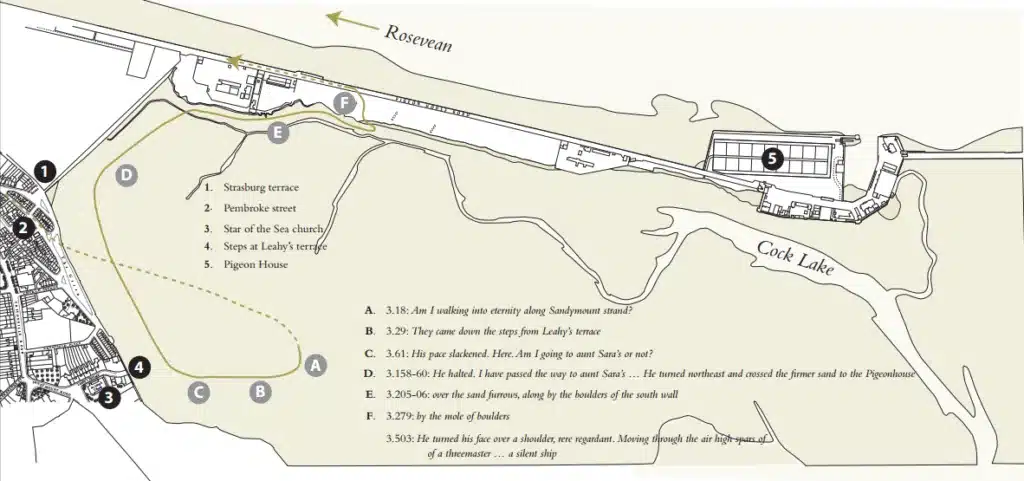
As an architect, having this visual reference helps me imagine the setting much better.
He is internally contemplating Jesus’s creed and the creation of Eve. It is really dense stuff, and I am going to unpack it gradually. These pages were certainly a bit heavier than the first 44 pages.
The ‘art’ in this chapter is monologue. Stephen wanders around the streets of Dublin after leaving Mr Deasy’s office, some nine miles from the school.
He is walking around in a disillusioned state, much like the Homeric parallel Proteus, who, in Homer’s Odyssey, is the god of transformation of earthly materials and can change forms.
Stephen rejects the Irish Revivalist position, an idea that the Irish could reclaim their Gaelic heritage to resist British colonial dominance and cultural assimilation. He prefers ex nihilo, which means ‘out of nothing’.
As Stephen walks along the Sandycove strand, he closes his eyes and listens to his surroundings. He hears the crackling and crushing of shells, pebbles, and sand beneath his feet. In these sounds, a rhythm emerges, and he tries, but fails, to recite a poem.
He sees two sisters walking down Leahy’s Terrace and guesses what is in their bag. It is a navel cord. He calls Eve a woman without a navel, meaning Eve does not have any birth parents. Perhaps this is similar to his own situation, in which he feels parentless.
I like the reference to ‘begotten, not made’, as it is a line from the Apostles’ Creed, which means that Jesus came forth from the Father and that both the Father and Jesus have always existed. Just like in the Bhagavad Gita, Krishna is the Supreme Personality of Godhead, and he too is said to be eternally existing, with no point in time when he did not exist.
I like the fact that several religions have similar reference points and conclusions without ever interacting with each other.
This usually happens to me when I am writing something. I come back to it after months or years and write what I think should happen next, only to discover that I had already written something similar, almost verbatim, on the following page. It really speaks to the idea that ‘All is one and one is all.’
Later, Stephen thinks about visiting his Aunt and imagines all the conversations that will take place: questions about his whereabouts, his job, and several other inquiries.
Because of this, he is hesitant to visit Aunt Sara’s home and walks past her house. Respect.
Well, that’s it from my side. If you’re enjoying my journey through James Joyce’s Ulysses, subscribe to my newsletter below to receive new reading updates directly in your inbox.
See you next time!